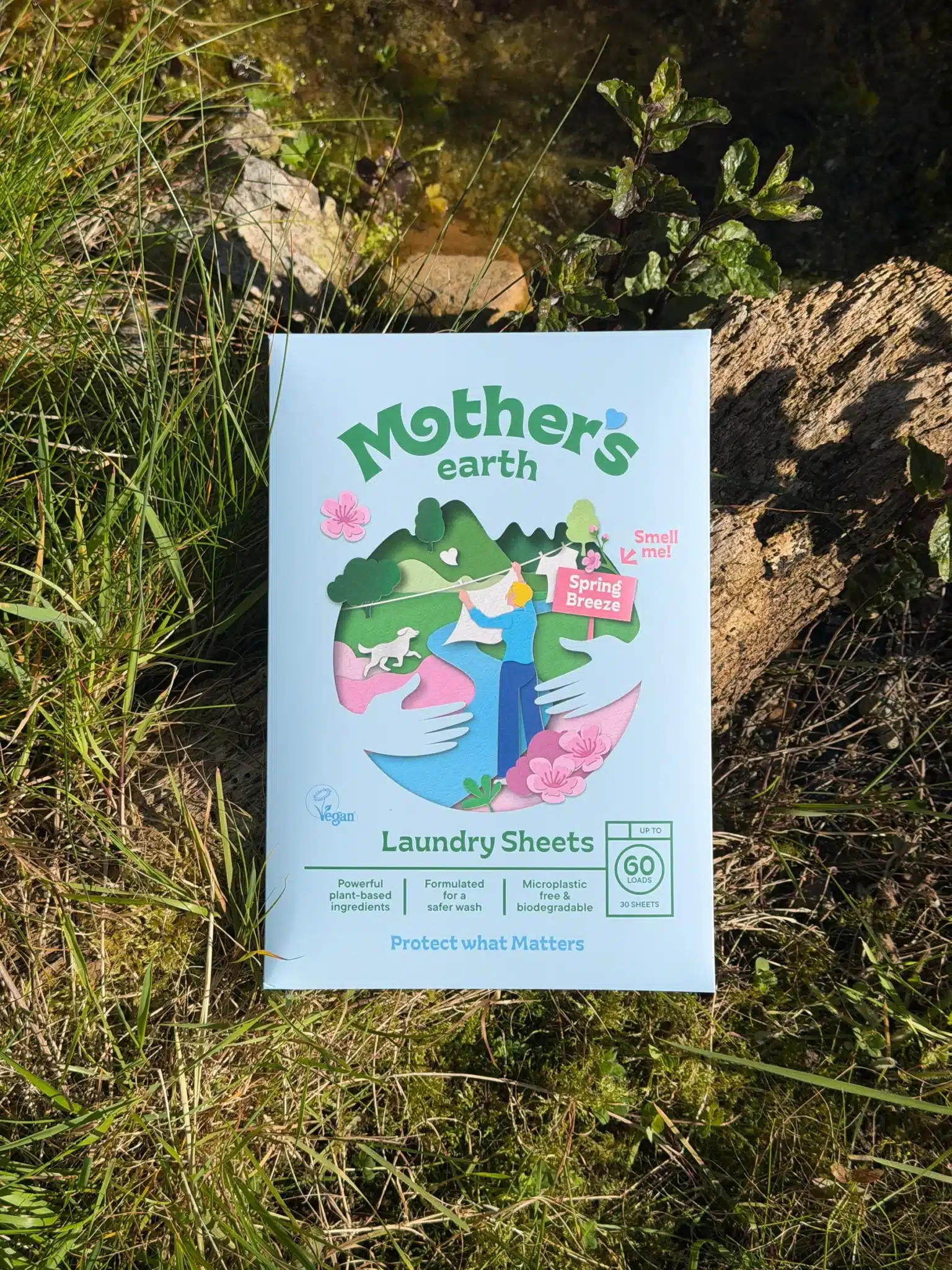
A family member handed me a box of Mother’s Earth Laundry Sheets and said, “You should try these and review them.” So this one didn’t come from us buying it or a brand sending it. It came from someone who genuinely thought I’d like them. I’m telling you that up front because it shapes the whole review. I went in wanting to like them.
And in a lot of ways, they’re fine. They clean. They smell lovely. They cut out the bulky plastic bottle. If you’re switching from a supermarket liquid and your main goal is less plastic and less clutter, these do the job.
But I stopped using them after a few weeks. Not because they failed, but because of what’s in them, and because of where I’m trying to take our laundry routine. This is the honest version of why.
What Mother’s Earth laundry sheets are
They’re a pre-dosed strip of concentrated detergent that dissolves in the wash. No measuring, no liquid, no jug. The box I had was Spring Breeze, 30 sheets, rated for “up to 60 loads”, because you’re meant to use one sheet for a large load and half a sheet for a small-to-medium one. It’s good for wash temperatures between 15° and 70°, works on all colours, and can be used for hand washing too. Not advised for wool and silk. The packaging is FSC Mix certified cardboard, and the whole pitch is on the front: “Powerful plant-based ingredients”, “Formulated for a safer wash”, “Microplastic free & biodegradable”, vegan. “Protect what Matters.”
It’s a nice-looking box with a warm story on the back. A mother-and-son company, a portion of sales donated to animals and families in need. I want to be fair to that. The intent reads as genuine.
| What the box says | The detail |
|---|---|
| Sheets in the box | 30 |
| Loads claimed | Up to 60, one sheet for a large load, half a sheet for small to medium |
| Wash temperature | 15° to 70° |
| Colours | All colours, and suitable for hand washing |
| Not advised for | Wool and silk |
| Scent tested | Spring Breeze. A Scent Free sheet is in the range |
| Packaging | FSC Mix certified cardboard, 150 g |
| Front-of-box claims | Powerful plant-based ingredients, Formulated for a safer wash, Microplastic free & biodegradable, vegan |
 The box
 The claims
How I actually used them
Slightly hard water here in Cork. 110 mg/l, right in the middle of the scale. Not the soft-water easy ride, and not the hard-water problem either. A lot of the online complaints about needing to double up on sheets come down to genuinely hard water, and that wasn’t my situation, but I wasn’t washing in soft water either.
I washed on my normal setting: a daily 40°C wash. I used half a sheet per load, because I’m not a fan of heavy fragrance and I wanted to keep it light. That’s not under-dosing, by the way. Half a sheet is the box’s own recommended amount for a small-to-medium load, and 30 sheets only reaches “up to 60 loads” if you’re halving them, so it’s the box’s own arithmetic. It’s only under-dosing if you halve a sheet into a full drum. For everyday loads in slightly hard water it cleaned perfectly well, so I never felt the need for more.
Where they genuinely won me over was bedding. Duvet covers and pillowcases came out smelling gorgeous. Fresh, clean, the kind of thing you notice when you get into bed. That was the high point.
Where they didn’t work for me was the kitchen. I didn’t like the fragrance on kitchen towels and cloths. When you’re cooking, and I cook a lot of Malaysian food, strong spices, sambal, the last thing you want is a floral-scented cloth fighting with your food. That’s a personal thing, but it’s real, and it’s the moment I started reaching for something else in the kitchen.
The one practical problem: the box’s own instruction works against it
Here’s the honest usage issue, and it’s a real one. When I overfilled the machine, the sheet didn’t fully dissolve. I’d find a gummy piece of it stuck to the inside of the door at the end of the cycle.
Here’s the thing, though. The box tells you to “place in the washing machine on top of the load of laundry.” That instruction is the problem. A sheet sitting on top of a packed drum is exactly the sheet that ends up pinned against the door glass before it ever properly wets through. A sheet needs water moving around it to break down, and a tightly packed drum doesn’t have enough free water circulating to do that.
So the fix is to ignore the box on this one. Don’t overload the machine, and put the sheet in the drum first, underneath the clothes, so it’s sitting in the water from the start rather than riding on top of a packed load. Two other things worth knowing: low wash temperatures are the other common cause of an undissolved sheet, so if you wash cold you’ll want to be extra careful about placement.
And this isn’t a dud box, it’s a limitation of the format. Liquid detergent doesn’t have this problem, because it disperses the second it hits the water, however full the drum is. It’s a trade-off you accept with any sheet detergent, not just this one. But telling people to lay it on top of the load, when that’s the surest way to leave half of it stuck to the door, is Mother’s Earth’s own instruction working against Mother’s Earth’s own product.
The scent: better than the supermarket, but still synthetic fragrance
Credit where it’s due. Spring Breeze smells good. Fresh and flowery, and crucially not chemically in the way a lot of supermarket detergents are. It doesn’t fill the whole room; it settles into the fabric and stays there gently. For someone who doesn’t like a strong smell, the strength was genuinely right. Not too much, not too faint.
But “smells natural” and “is natural” aren’t the same thing, and this is where I have to be straight with you. The fragrance is a synthetic perfume, and the ingredient panel on the box declares five fragrance allergens: Linalool, Hexyl Cinnamal, Citronellol, Benzyl Benzoate and Limonene. Those are printed on the box precisely because EU law requires known allergens to be declared. But the allergen picture is actually broader than those five. The hazard block lists two more sensitisers, hexyl salicylate and delta-damascone, plus the enzyme subtilisin and two surfactants, all under “may produce an allergic reaction”. So the real count for a fragrance-sensitive reader is higher than the perfume line alone suggests. For most people none of this matters. But if you or anyone in your house has sensitive skin or reacts to fragrance, that’s the fuller list to look at, and it’s the reason a “safer wash” claim deserves a second read.
The bit that made me put them down: toxicity and the honest tension
The front of the box says “Protect what Matters” and “Formulated for a safer wash”. The back of the box carries a formal hazard warning. Signal word: Danger. Causes skin irritation. Causes serious eye damage. Harmful to aquatic life with long lasting effects. There’s a corrosion pictogram to go with it.

I don’t say that to scare anyone. That labelling describes the neat product, not your washed clothes, and detergents commonly carry warnings. But I’d assumed my own detergent carried much the same wording, and when I actually checked, it didn’t. My fragrance-free Ecover Zero is classified only for eye irritation, one category down, with the signal word Warning, and it’s explicitly not classified for skin irritation and carries no mixture-level aquatic warning at all. So the gap I half-suspected turned out to be real, and bigger than I thought: this box is a full step harsher than the liquid I already use. That sits awkwardly against the gentle, hugging-the-earth marketing, and I think an eco-minded buyer deserves to have it pointed out rather than glossed over.
I’m actively trying to reduce the toxic load in how we live. Fewer synthetic fragrances, fewer question-mark ingredients. Once I clocked the allergen list and the hazard labelling together, this box stopped fitting the direction I’m going in. That’s not a product failure. It’s a mismatch between the product and the household.
The PVA question: both sides, because it’s genuinely unsettled
There’s one more thing eco buyers should understand about nearly all laundry sheets, including this one: what holds the sheet together.
Sheets are bound with PVA (polyvinyl alcohol), a synthetic, water-soluble polymer. And here’s the part that bothered me most. PVA isn’t named anywhere on the box. The panel a shopper reads in the aisle declares only the surfactant bands, the enzymes and the five perfume allergens, then points you to the website for the “complete ingredients list”. Go to that website list and PVA is right there, listed first. So the front of the box says “Microplastic free”, and the exact ingredient that claim turns on isn’t printed anywhere you could read it while deciding whether to buy. It’s legal. The EU Detergents Regulation only requires those classes to be on the pack. But for a product sold on being microplastic-free, to the eco buyer who cares about precisely this, that’s a real transparency gap.
While we’re on that website list: of the ten ingredients on it, four are labelled Synthetic by the brand itself, including the first two. That’s the brand’s own labelling, sitting under a front-of-box banner that reads “Powerful plant-based ingredients”.
Whether PVA itself is a problem is genuinely contested, so here are both sides honestly.
The case that it’s fine: Industry bodies like the American Cleaning Institute, and several brands, say detergent-grade PVA is designed to dissolve completely and then biodegrade in wastewater treatment. On the regulatory side, when a 2023 petition asked the US EPA to require PVA testing, the EPA turned it down and kept PVA on its Safer Choice list. And under EU rules PVA film like this isn’t classified as a microplastic, so the box’s “microplastic free” claim is defensible as written. Worth being precise about that last one, though: PVA is excluded from the microplastic definition by a solubility threshold, because it dissolves, not by any finding that it’s harmless or that it fully biodegrades. No regulator has affirmed that it does.
The case for caution: Independent critics, such as the campaign group Beyond Plastics, argue PVA is petroleum-derived and that in the real world it dissolves but doesn’t fully biodegrade, with a large share passing through treatment plants intact. The often-quoted figure that about 75% is released undegraded comes from a 2021 modelling study, not a measurement, and one funded in part by Blueland, a brand that sells PVA-free products. I mention that for the same reason I mention the industry’s commercial interest: you should know who funded which side. Beyond that, critics point to studies detecting PVA in the wider environment and in human breast milk, and note it can bind to pollutants like lead. This side says a dissolved plastic is still a plastic; it’s just changed shape.
My honest read: the science isn’t settled, and reasonable people land in different places. I’m not going to tell you PVA is definitely harmful, because the evidence doesn’t support certainty in either direction. But if your reason for buying laundry sheets is specifically to get plastic out of your routine, you should know the sheet itself contains a synthetic polymer, and decide for yourself whether “dissolves and is EU-compliant” is good enough for you, or whether a PVA-free powder in cardboard is closer to what you actually wanted.
One fair thing to add, because it’s to the brand’s credit: in March 2026 Mother’s Earth launched a PVA-free sheet, reported as Europe’s first, sold alongside the ones I tested. So the exact objection I’m raising is one the brand has since acted on. If the PVA binder is your sticking point, that’s the version to look at rather than this one.
What I switched back to
I went back to what I was using before: Ecover non-bio laundry liquid, refilled at our local zero-waste shop. For me that hits the balance. It cleans, it has just enough fragrance and no more, and refilling keeps the plastic down without asking me to accept a synthetic binder. Honestly, if my refill shop stocked a completely fragrance-free option, I’d take that in a heartbeat. Less scent, not more, is the direction I want.
That’s a me decision, though, not a knock on Mother’s Earth. Which brings me to the point of a review: who is this actually for?
Who should buy Mother’s Earth laundry sheets, and who shouldn’t
- Are switching from a supermarket plastic bottle and mainly want less plastic and less clutter
- Have soft to moderately hard water (in genuinely hard water you’ll likely need a full sheet or more)
- Like a light, pleasant scent on your laundry and bedding, or want the fragrance-free option (there’s a Scent Free sheet in the range)
- Travel, or have a small flat with no room for detergent jugs
- Want an easy, no-measuring, no-leak routine
- Are actively cutting synthetic fragrance and reducing your toxic load (that’s me). And note the Scent Free version doesn’t get you out of the other two objections below, since the PVA binder and the hazard labelling apply to it just the same
- Have fragrance-sensitive skin, so check that fuller allergen list first
- Bought sheets specifically to eliminate plastic, and the PVA binder defeats the point for you (if so, look at their newer PVA-free sheet instead)
- Regularly wash heavily soiled or very full loads (the dissolving issue, plus you’ll need more product)
- Wash a lot of wool or silk, since the box says not advised, and I’d listen
The verdict: 3 / 5
Mother’s Earth Laundry Sheets
Spring Breeze · 30 sheets · several weeks of daily washingA decent product that isn’t the right product for how we live.
Mother’s Earth Laundry Sheets clean well, smell genuinely nice, and cut the plastic of a liquid bottle. The company’s intentions read as sincere, and for the plastic-reduction-first buyer with soft to moderately hard water, these are an easy, tidy swap. That’s a real, honest three stars. Not a bad score, a middle one.
They lose the top marks for reasons that are about fit and transparency rather than performance: a synthetic fragrance carrying more declared sensitisers than the perfume line alone suggests, a Danger-rated formula that sits a full step harsher than the fragrance-free liquid I already use, a PVA binder that isn’t named on the box yet undercuts the plastic-free reason many people buy sheets in the first place, and a dissolving problem that the box’s own “place on top” instruction makes more likely, not less.
If you’re at the start of your low-plastic journey, these could genuinely help you leave the big detergent bottle behind. If you’re further down the low-tox road, like I am, you’ll probably read the back of the box and quietly reach for something else. Both of those can be true at once, and that’s exactly why I’d rather tell you where it landed for me and let you decide where it lands for you.
A family member gave us this box to test. As always, nobody paid for this review and the verdict is entirely our own. This page may contain affiliate links; if you buy through them we earn a small commission at no extra cost to you.
Frequently asked
When I overfilled the machine, the sheet didn’t fully dissolve, and I’d find a gummy piece of it stuck to the inside of the door at the end of the cycle. A sheet sitting on top of a packed drum is exactly the sheet that ends up pinned against the door glass before it ever properly wets through. Don’t overload the machine, and put the sheet in the drum first, underneath the clothes. Low wash temperatures are the other common cause.
Yes, and it isn’t under-dosing. Half a sheet is the box’s own recommended amount for a small-to-medium load, and 30 sheets only reaches “up to 60 loads” if you’re halving them, so it’s the box’s own arithmetic. It’s only under-dosing if you halve a sheet into a full drum. For everyday loads in slightly hard water it cleaned perfectly well.
Our water in Cork is slightly hard, 110 mg/l, right in the middle of the scale, and half a sheet cleaned everyday loads perfectly well. A lot of the online complaints about needing to double up on sheets come down to genuinely hard water. In genuinely hard water you’ll likely need a full sheet or more.
Yes. Sheets are bound with PVA (polyvinyl alcohol), a synthetic, water-soluble polymer, and PVA isn’t named anywhere on the box. The panel a shopper reads in the aisle declares only the surfactant bands, the enzymes and the five perfume allergens, then points you to the website for the “complete ingredients list”. Go to that website list and PVA is right there, listed first. In March 2026 Mother’s Earth launched a PVA-free sheet, sold alongside the ones I tested.
No. The box says not advised for wool and silk, and I’d listen. It is good for wash temperatures between 15° and 70°, works on all colours, and can be used for hand washing too.
There’s a Scent Free sheet in the range, so yes if fragrance is your only concern. But note the Scent Free version doesn’t get you out of the other two objections, since the PVA binder and the hazard labelling apply to it just the same.